
AI Is Changing Investing: How Investors Can Identify Opportunities Beyond the AI Hype
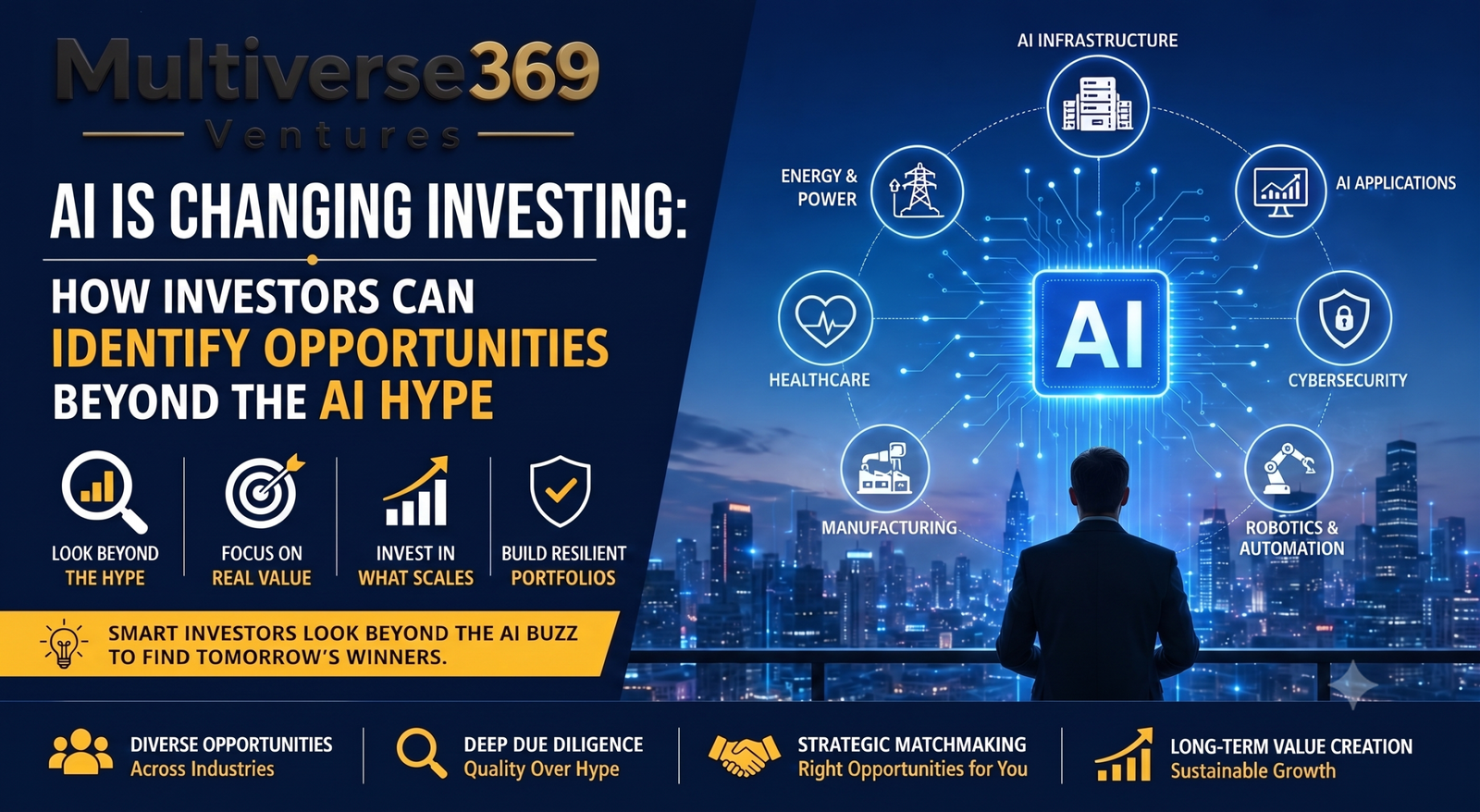
Artificial intelligence has become one of the defining investment themes of the decade. Capital is flowing into AI companies, semiconductor businesses, data centers, cloud infrastructure, robotics, cybersecurity, energy infrastructure and AI-enabled businesses at extraordinary speed.
But this creates a difficult problem for investors. When almost every company describes itself as “AI-powered,” how can investors distinguish genuine investment opportunities from businesses simply attaching themselves to the AI narrative?
That question is becoming increasingly important in 2026.
According to Stanford University’s 2026 AI Index, global corporate AI investment more than doubled in 2025. Private investment grew 127.5%, while generative AI captured nearly half of private AI funding. U.S. private AI investment reached $285.9 billion in 2025, compared with $12.4 billion in China. (Stanford HAI)
The numbers demonstrate that AI is not merely a speculative technology trend. It is attracting enormous amounts of real capital. But large capital flows do not automatically mean every AI investment is attractive.
“Look beyond the AI label. Look for the economic value created around AI.”
The AI Investment Boom Is Real — But So Is the Hype
There are legitimate reasons for investors to be interested in artificial intelligence. AI is already being adopted across software development, healthcare, financial services, manufacturing, logistics, customer service, cybersecurity, marketing, education and scientific research.
Stanford’s 2025 AI Index found that 78% of organizations reported using AI in 2024, compared with 55% in 2023. Generative AI usage also expanded sharply across business functions. (Stanford HAI)
The technology is therefore moving beyond experimentation. However, the investment market introduces another variable: Expectations.
A company can have excellent technology but still be a poor investment if:
- The valuation is excessive.
- Customer acquisition costs are unsustainable.
- Margins are weak.
- The technology can easily be replicated.
- The company has no defensible distribution advantage.
- Revenue depends on one customer.
- AI infrastructure costs consume most of the revenue.
- The business has little pricing power.
- Future growth expectations are already fully reflected in its valuation.
A great technology is not automatically a great investment.
Investors ultimately need to understand the relationship between economic drivers. That framework is more useful than simply asking: “Is this company using AI?”
The Biggest Investment Mistake: Confusing AI Exposure With AI Value Creation
Company A (The Hype)
A startup adds an AI chatbot to an existing software product. It has limited differentiation, no proprietary data, no significant customer lock-in, high dependence on third-party AI models, modest revenue, and an aggressive valuation.
Company B (The Value)
A company provides specialized industrial automation for manufacturers. Its technology combines proprietary operational data, machine vision, robotics, AI-powered predictive maintenance, integration with factory systems, and long-term enterprise contracts.
Company B may not generate the same excitement on social media. But from an investment perspective, it could potentially have a stronger economic moat. Investors should evaluate how AI creates competitive advantage—not merely whether AI appears in the company’s pitch deck.
Where Could the Next AI Investment Opportunities Actually Be?
The AI economy is much larger than AI model developers. A useful way to analyze the ecosystem is to divide it into several layers.
1. AI Infrastructure
AI requires enormous physical and digital infrastructure. That includes semiconductors, advanced memory, networking, data centers, cloud computing, cybersecurity, power generation, transformers, cooling systems, optical networking, and fiber connectivity.
Why investors should care: Instead of trying to identify which AI application becomes the next dominant platform, investors can investigate the businesses that provide the infrastructure required by many competing AI companies.
2. Power and Energy Infrastructure
One of the less obvious consequences of AI is that artificial intelligence is becoming an energy story. Large-scale AI computing requires enormous amounts of electricity. As data-center construction accelerates, the investment opportunity can extend beyond technology companies into electricity generation, transmission infrastructure, grid modernization, and renewable energy.
3. AI Applications in Traditional Industries
Some of the most interesting opportunities may come from businesses that use AI to improve an existing industry rather than trying to build another general-purpose AI model.
- Healthcare: Diagnostics, medical imaging, drug discovery, clinical workflows.
- Manufacturing: Predictive maintenance, quality control, production optimization.
- Logistics: Route optimization, warehouse automation, fleet management.
- Financial Services: Fraud detection, underwriting, risk analysis.
- Agriculture: Precision farming, yield forecasting, agricultural robotics.
4. Cybersecurity Could Become an AI-Driven Investment Theme
AI doesn’t only create new capabilities for businesses; it also creates new capabilities for attackers. Every new technology wave creates both opportunities and new categories of risk. Businesses solving those risks—via AI model security, data security, and automated threat detection—can potentially become valuable investment targets.
5. Robotics and Physical Automation
AI is increasingly moving from digital environments into the physical world. Investors should distinguish between robotics companies with genuine deployment economics and businesses that are primarily demonstrating impressive prototypes.
6. AI Doesn’t Mean Investors Should Ignore Non-AI Businesses
An AI-heavy portfolio isn’t necessarily a diversified portfolio. Therefore, investors should also investigate businesses where AI is not the primary investment thesis. Potential areas include private credit, real estate, infrastructure, healthcare, consumer businesses, and established profitable SMEs.
How Investors Can Identify an AI Investment Opportunity Worth Investigating
- Start With the Problem: What real economic problem does this company solve?
- Measure the Customer Value: Does the product increase revenue, reduce costs, or improve productivity?
- Examine the Revenue Model: Does revenue scale faster than costs?
- Investigate AI Dependency: Does the company own critical technology, or does it simply sit on top of another company’s model?
- Examine the Moat: Look for proprietary datasets, patents, distribution, and network effects.
- Look at Unit Economics: Analyze Customer Acquisition Cost versus Customer Lifetime Value.
- Challenge the Valuation: What growth is already priced into this valuation?
- Analyze the Downside: What happens if AI spending slows or competitors reduce prices?
AI Investment Due Diligence: A Practical Checklist
| Category | Questions to Ask |
|---|---|
| Problem | What real problem is being solved? |
| Product | Is the product genuinely differentiated? |
| Customers | Who actually pays? |
| Revenue | How predictable is revenue? |
| Growth | Is growth organic and sustainable? |
| Margins | Can margins improve with scale? |
| AI Dependency | How dependent is the business on third-party models? |
| Data | Does the company have proprietary data advantages? |
| Competition | Who could replicate the business? |
| Moat | What makes the company difficult to replace? |
| Capital | How much additional funding is required? |
| Valuation | Is the valuation supported by fundamentals? |
| Management | Does the leadership team have relevant execution capability? |
| Risk | What could permanently impair capital? |
| Exit | Who could realistically acquire or invest in the company later? |
How Multiverse369 Ventures Can Help Investors Look Beyond the AI Hype
For investors, one of the biggest challenges isn’t necessarily finding another AI company. It is finding relevant opportunities that match their specific investment mandate.
This is where Multiverse369 Ventures can potentially become part of the investor’s opportunity-sourcing process. The company’s Investor Partnership Program connects investment-ready businesses with capital partners.
- Investors Define Their Mandate: Preferred sectors, stage, geography, and ticket size.
- Multiverse369 Ventures Sources Opportunities: Across multiple industries, not just fashionable tech.
- Businesses Undergo Initial Review: Company verification, financial review, and pitch-deck assessment.
- Potential Matches Are Introduced: Aligned precisely with the investor’s criteria.
The Future of AI Investing May Be Less About “AI”
The next generation of successful AI-related investments may come from companies that don’t market themselves as revolutionary AI companies. They may be the power company supplying the data center, the cybersecurity firm protecting infrastructure, or the logistics company reducing delivery costs.
The technology is only one component. The economics are what ultimately matter.
Final Takeaway: Don’t Invest in the AI Story. Investigate the Economics.
Artificial intelligence is likely to remain one of the most powerful technological forces shaping the global economy. The investment question, however, is becoming more sophisticated. It is no longer enough to ask: “Is this an AI company?”
Investor Opportunity with Multiverse369 Ventures
Explore the Multiverse369 Ventures Investor Partnership Program today.
- Define your investment mandate.
- Access potentially relevant opportunities.
- Review investment-ready businesses.
- Conduct your own due diligence.
- Invest where the opportunity fits your strategy.